

Autor: LOUYS. (Pierre)
Idioma: Francês / French
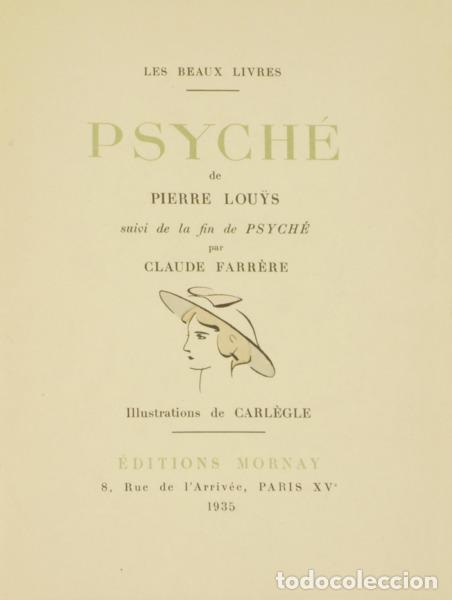
de... Suivi de la fin de Psyché par Claude Farrère. Illustrations de Carlègle. Les Beaux Livres, 71. Éditions Mornay. Paris. 1935.
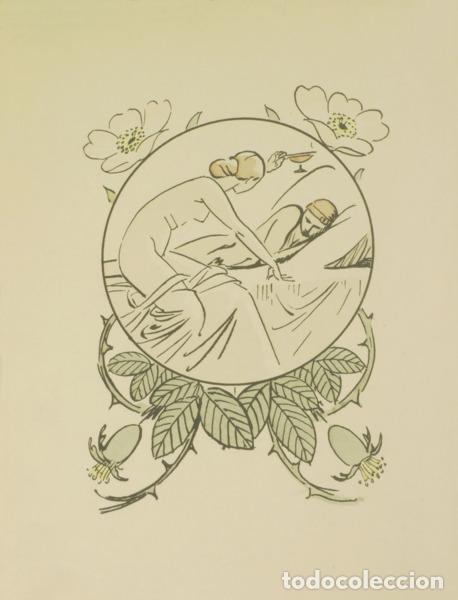
De 20,5x15,5 cm. Com 229, [ii] págs. Brochado. Ilustrado no texto com desenhos a cores de Carlègle (Charles Émile Egli, 1877-1937).
Exemplar N.º 22 de uma tiragem de 25, impresso sobre papel Japão.
Impresso numa tiragem de 1700 exemplares destinados à venda, distribuídos da seguinte forma: 25 em papel Japão Imperial, numerados de I a 25, contendo cada um um esboço de Carlègle; 40 em papel Van Gelder, da Holanda, numerados de 26 a 65, contendo um esboço do artista; e 1635 em papel Rives, impressos à forma, numerados de 66 a 1700. Além disso, foram produzidos 65 exemplares fora do comércio, dos quais 7 em papel Japão, 7 em papel Holanda e 51 em papel Rives.
Composta em tipo Didot, concluída a impressão em 10 de Outubro de 1935, nas prensas da Union Typographique, em Villeneuve-Saint-Georges, para as Éditions Mornay, sendo Marc Michon administrador-delegado e Valère Bachmann director.
A primeira edição foi publicada postumamente em 1927, pela Albin Michel, Paris. Ano seguinte foi publicada nos Estados Unidos, pela Covici, Friede, edição inglesa intitulada Psyche, que incluía a conclusão e as notas de Claude Farrère e ilustrações de Majeska Covici. Em 1931 surgiu uma nova edição inglesa de Psyche, igualmente publicada pela Covici e 1935, a editora Mornay, publicou uma nova edição francesa, ilustrada por Carlègle. Mais tarde, em 1973, as Éditions de l'Ibis publicaram uma edição de luxo de Psyché, ilustrada com doze composições originais de Guily Joffrin, integrada na colecção Chefs-d'uvres de Pierre Louÿs, 4.
Romance de carácter simbólico e sensual que explora o amor, o desejo e a procura da beleza através de uma atmosfera inspirada na Antiguidade clássica. Inacabada à morte do autor, em 1925, a obra foi completada por Claude Farrère, que escreveu as páginas finais para a sua publicação póstuma em 1927.
Ao contrário de outras obras do autor ambientadas na Antiguidade (como Afrodite), Psyché decorre na Paris contemporânea da sua época. A história acompanha a intensa e explícita relação amorosa entre Aimery Jouvelle e Psyché Vannetty. O romance funciona como uma reinterpretação livre e sensual do mito clássico de Cupido e Psique relatado por Apuleio. Elementos simbólicos, como o uso de uma lâmpada numa cena de reconhecimento amoroso, ecoam diretamente o mito original.
O livro inclui também o célebre poema lírico e melancólico "Pervigilium Mortis", escrito por Louÿs para a sua amante Marie de Régnier (pag. 196/197). O poema surge associado ao momento em que a protagonista feminina (Psyché) acende uma lâmpada na penumbra para ler uma carta crucial enviada pelo seu amante Aimery. Os versos do poema irrompem na narrativa para traduzir a profunda e melancólica fusão entre o amor carnal absoluto e a premonição da morte.
Pierre Louÿs (Gand (Ghent), Belgique, 1870 Paris, 1925), foi um poeta e romancista de língua francesa, associado ao Simbolismo e ao movimento decadentista. Tornou-se célebre pelas obras de inspiração clássica e sensual, entre as quais Les Chansons de Bilitis (1894) e Aphrodite (1896). A sua escrita caracteriza-se pelo refinamento formal, pelo erotismo e pela evocação do mundo greco-romano. Psyché, uma das suas últimas obras, permaneceu inacabada à sua morte e foi publicada postumamente em 1927.
Claude Farrère, pseudónimo de Frédéric-Charles Bargone (Lyon, 18761957), foi um escritor, ensaísta e oficial da Marinha francesa. Ingressou na Escola Naval em 1894 e abandonou a carreira militar em 1919 para se dedicar inteiramente à literatura. Recebeu o Prémio Goncourt em 1905 pelo romance Les Civilisés e tornou-se conhecido pelos seus romances de temática exótica, inspirados também nas suas viagens pelo Extremo Oriente. Em 1935 foi eleito membro da Académie Française, ocupando o fauteuil 28.
Carlègle é pseudónimo de Charles Émile Egli (Aigle, Suiça, 1877 - Paris, 1937) foi um ilustrador e pintor suíço que passou a maior parte de sua vida em Paris. Tornou-se conhecido em diários satíricos como Le Rire, Le Sourire, La Vie Parisienne, L'Assiette au Beurre, Fantasio, La Gazette do Bon Ton, Les Humoristes e Qui lit rit.
[EN] 20.5 × 15.5 cm. 229, [ii] pp. Paperback. Illustrated throughout with colour drawings by Carlègle (Charles Émile Egli, 18771937).
Copy No. 22 of a print run of 25, printed on Japan paper.
Printed in a run of 1,700 copies intended for sale, distributed as follows: 25 on Imperial Japan paper, numbered I to 25, each containing a sketch by Carlègle; 40 on Van Gelder paper from the Netherlands, numbered from 26 to 65, each containing a sketch by the artist; and 1,635 on Rives paper, block-printed, numbered from 66 to 1,700. In addition, 65 non-commercial copies were produced, of which 7 were on Japan paper, 7 on Dutch paper and 51 on Rives paper.
Set in Didot typeface, printing was completed on 10 October 1935 on the presses of the Union Typographique in Villeneuve-Saint-Georges for Éditions Mornay, with Marc Michon as managing director and Valère Bachmann as director.
The first edition was published posthumously in 1927 by Albin Michel, Paris. The following year, Covici published it in the United States, Friede published an English edition, entitled Psyche, which included the conclusion and notes by Claude Farrère, as well as illustrations by Majeska Covici. In 1931, a new English edition of Psyche appeared, also published by Covici, and in 1935, the publisher Mornay published a new French edition, illustrated by Carlègle. Later, in 1973, Éditions de lIbis published a deluxe edition of Psyché, illustrated with twelve original compositions by Guily Joffrin, as part of the Chefs-duvres de Pierre Louÿs collection, vol. 4.
A symbolic and sensual novel that explores love, desire and the quest for beauty through an atmosphere inspired by classical antiquity. Left unfinished upon the authors death in 1925, the work was completed by Claude Farrère, who wrote the final pages for its posthumous publication in 1927.
Unlike the authors other works set in antiquity (such as Aphrodite), Psyché is set in the Paris of his own time. The story follows the intense and explicit romantic relationship between Aimery Jouvelle and Psyché Vannetty. The novel serves as a free and sensual reinterpretation of the classical myth of Cupid and Psyche as recounted by Apuleius. Symbolic elements, such as the use of a lamp in a scene of romantic recognition, directly echo the original myth.
The book also includes the famous lyrical and melancholic poem Pervigilium Mortis, written by Louÿs for his lover Marie de Régnier (pp. 196197). The poem appears at the moment when the female protagonist (Psyché) lights a lamp in the dim light to read a crucial letter sent by her lover Aimery. The verses of the poem burst into the narrative to convey the profound and melancholic fusion between absolute carnal love and the premonition of death.
Pierre Louÿs (Ghent, Belgium, 1870 Paris, 1925), was a French-language poet and novelist associated with Symbolism and the Decadent movement. He became famous for his classically inspired and sensual works, including Les Chansons de Bilitis (1894) and Aphrodite (1896). His writing is characterised by formal refinement, eroticism and evocations of the Greco-Roman world. Psyché, one of his last works, remained unfinished at the time of his death and was published posthumously in 1927.
Claude Farrère, the pen name of Frédéric-Charles Bargone (Lyon, 18761957), was a writer, essayist and officer in the French Navy. He entered the Naval Academy in 1894 and left the military in 1919 to devote himself entirely to literature. He was awarded the Prix Goncourt in 1905 for the novel Les Civilisés and became known for his novels with exotic themes, which were also inspired by his travels in the Far East. In 1935, he was elected a member of the Académie Française, occupying fauteuil 28.
Carlègle was the pseudonym of Charles Émile Egli (Aigle, Switzerland, 1877 Paris, 1937), a Swiss illustrator and painter who spent most of his life in Paris. He became known through satirical magazines such as Le Rire, Le Sourire, La Vie Parisienne, LAssiette au Beurre, Fantasio, La Gazette du Bon Ton, Les Humoristes and Qui lit rit.
Ref.:
BNF, Cota: ark:/12148/cb32396695n; FRBNF32396695


Portugal (Lisboa)
Ver más lotes de Louys.


 Español
 English
 Deutsch
 Français
 Português
 Italiano